---
title: "October 2025 Restaurant Sales Trends: Sun Belt Dominance Continues"
description: Explore October 2025 restaurant sales trends, top buyer activity, and Sun Belt market performance from the nation’s leading restaurant brokerage.
image: https://blog.wesellrestaurants.com/hubfs/YouTube%20Thumbnail%20-%20Selling-Dec-01-2025-10-30-05-1092-PM.png
---
[](https://www.wesellrestaurants.com)
Questions? Call or Text [ 404-800-6700](tel:%20404-800-6700)
[Sign In | Register](https://www.wesellrestaurants.com/?showLogin=true) **
- [](https://www.wesellrestaurants.com/listings.php)
#### [Browse](https://www.wesellrestaurants.com/listings.php)
# [Restaurants for sale](https://www.wesellrestaurants.com/listings.php)
# October 2025 Restaurant Sales Trends: Sun Belt Dominance Continues
Posted by [Robin Gagnon](https://blog.wesellrestaurants.com/author/robin-gagnon) on Dec 2, 2025 11:59:59 AM
Each month, [We Sell Restaurants](https://www.wesellrestaurants.com/) analyzes activity across our national inventory to understand buyer behavior and transaction patterns. October reinforced the strong trends we've observed throughout 2025. Sun Belt markets dominated activity, buyers favored manageable concepts with clear operating models, and well-positioned listings moved rapidly from inquiry to closing. The patterns we're seeing represent more than seasonal fluctuations. They reflect fundamental shifts in where restaurant buyers are looking, what they're buying, and how quickly they're willing to move on the right opportunity.
With over $558 million in listing inventory spanning more than 1,300 restaurants, our database represents the largest sample of restaurant transactions nationwide, offering unparalleled insight into buyer preferences and market dynamics. This scale matters because it eliminates the noise that can distort smaller data sets. When we report trends, they're based on hundreds of actual buyer interactions and dozens of completed transactions, not anecdotal observations.
**Our Methodology**
This analysis draws from four key data sets, focusing on the top 25 listings plus all completed sales:
- New buyer inquiries
- Signed confidentiality agreements
- Google Analytics traffic
- Closed transactions
Together, these metrics provide a complete view of the buyer journey from initial interest through final closing.
**Where Buyer Interest Concentrated**
New inquiries in October showed heavy concentration in three states: Florida, Texas, and Georgia accounted for more than two-thirds of top-performing listings.
**Winning Concept Categories:**
**Cafes, Bakeries & Coffee Shops** formed the strongest cluster. Buyers continue prioritizing these models for their limited hours, straightforward operations, and manageable ownership requirements. The appeal is obvious: these concepts typically operate six to eight hours per day, require smaller staffing teams, and offer predictable revenue patterns. For first-time buyers or entrepreneurs looking to maintain work-life balance, these models present lower barriers to entry while still generating solid returns.
**Breakfast & Lunch Concepts** reinforced the trend toward daytime-only operations with predictable staffing, streamlined menus, and strong profitability without dinner service complexity. These operations avoid the challenges of late-night labor, alcohol service complications, and the intensive prep requirements of full dinner menus. Buyers appreciate the ability to close by mid-afternoon while still capturing strong customer counts during peak morning and lunch periods.
**Turnkey Second-Generation Spaces** equipped with hoods, grease traps, and complete buildouts attracted buyers seeking to launch their own concepts, convert to franchises, or avoid construction delays entirely. In a market where permitting and construction can add six to twelve months and hundreds of thousands of dollars to a project, fully equipped spaces represent immediate opportunity. Buyers can often open within 30 to 60 days of closing, dramatically reducing carrying costs and accelerating the path to revenue.
**Franchise Opportunities** generated significant attention for their brand recognition, proven systems, and lower perceived risk profiles. Established franchise brands offer operating playbooks, supplier relationships, marketing support, and proven unit economics. For buyers without restaurant experience, these advantages justify franchise fees and ongoing royalties. The transfer process may take longer, but buyers view the operational support as worth the additional timeline.
**The Common Thread:** Top-performing listings shared three critical qualities: approachable pricing, clear value propositions, and favorable locations. These factors determined which opportunities advanced quickly through the sales funnel. Pricing needed to align with current market multiples and cash flow realities. Value propositions needed to be immediately obvious from listing descriptions and financial summaries. Locations needed to demonstrate strong traffic patterns, favorable lease terms, and growth trajectories in their immediate trade areas.
**Mid-Funnel Engagement: Confidentiality Agreements**
Signed confidentiality agreements represent serious buyer intent. October's geographic distribution:
- **Florida:** 32% of top CA signings
- **North Carolina:** 24%
- **Texas:** 20%
Strong performers at the inquiry stage maintained momentum at the CA stage. High-earning Central Florida restaurants, Charlotte cafes, turnkey Arizona concepts, and high-traffic North Texas locations drew consistent engagement, signaling sustained acquisition opportunity in these markets.
**Google Analytics Validation**
Search traffic data confirmed buyer preferences. The most-viewed listings came overwhelmingly from Texas, Florida, and North Carolina.
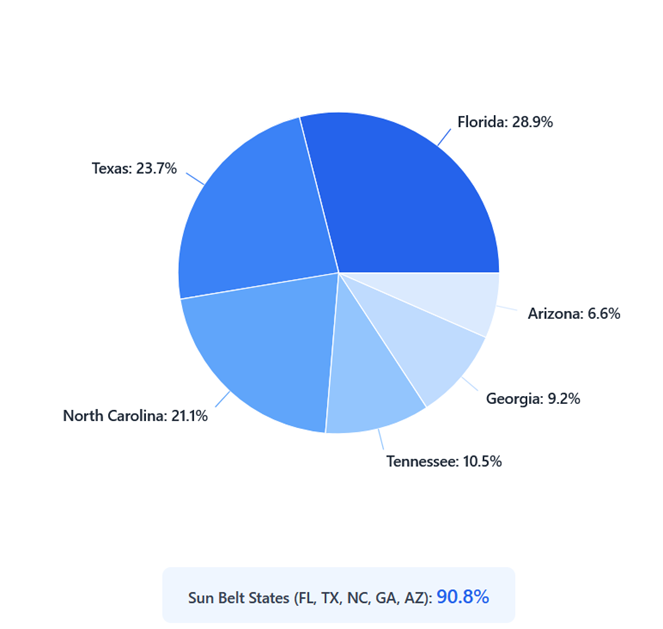
Seven listings ranked highly across all three engagement metrics simultaneously: new inquiries, signed CAs, and Google views. This triple convergence signals correct pricing, effective positioning, and strong market demand. When a listing performs across all channels, it indicates that the opportunity appeals to browsers, satisfies the scrutiny of serious buyers, and withstands detailed financial review. These are the listings that typically receive multiple offers and close at or above asking price.
**October Closings: Understanding the Impact of the SBA Shutdown**
October 2025 presented unique challenges. The government shutdown from October 2 through November 12 halted all SBA lending activity. Even deals with approved financing couldn't close without SBA personnel available to process payoffs. This created an unprecedented bottleneck expected to delay transactions into early 2026 as the agency works through accumulated applications. The impact extended beyond the shutdown period itself. Deals that would normally have closed in late October or November were pushed into December and January, creating a ripple effect that compressed the traditional year-end transaction window.
The shutdown's immediate effect was a lower median selling price of **$140,000** as high-value deals requiring financing were frozen. This figure doesn't reflect reduced valuations but rather the temporary absence of financed transactions from the closing pool. Cash deals and smaller asset sales continued to close, but the six-figure opportunities that typically drive median prices higher sat in limbo waiting for government operations to resume.
**Key Transaction Metrics:**
- **Median days on market:** 126 days
- **60%** of sales closed within 180 days
- **33%** closed within 90 days
- **Three listings** closed in under 60 days—all second-generation asset sales priced at or below $120,000
**Independent vs. Franchise Timeline:** Independent restaurants sold in a median 101 days versus 168 days for franchise resales. Independent transfers typically involve simpler processes and asset-based structures. Franchise resales require additional steps including disclosure requirements, franchisor approval, and mandatory training, extending timelines even with strong buyer demand.
**Outperforming National Benchmarks**
BizBuySell's 2025 quarterly benchmarks for all business types:
- Q1 2025: 205 days
- Q2 2025: 204 days
- Q3 2025: 172 days
- 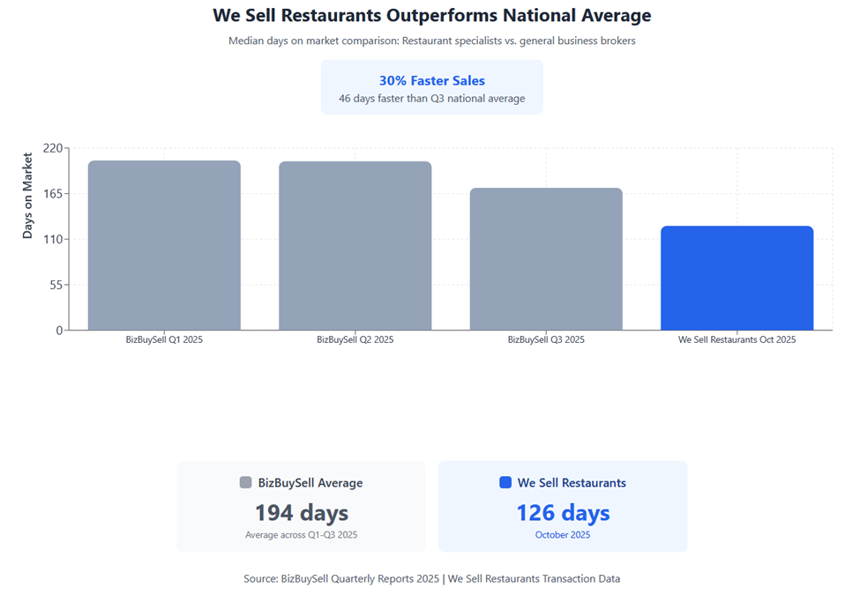
**We Sell Restaurants outperformed the latest national average by 46 days, selling inventory 30% faster.** This meaningful difference reflects the advantage of well-prepared listings combined with a specialized brokerage model focused exclusively on restaurants. General business brokers handle everything from dry cleaners to manufacturing operations. Restaurant-focused brokers understand the specific financial metrics, operational considerations, and buyer concerns that matter in this industry. That expertise translates directly into faster transactions.
**Why the Sun Belt Continues to Dominate**
Florida captured 35% of October closings, with Texas, Georgia, the Carolinas, Arizona, and Colorado contributing strong numbers. This isn't coincidental—the Sun Belt remains the primary engine of U.S. economic growth heading into 2026.
**Economic Fundamentals Driving Restaurant Sales:**
**Population Growth:** Florida, Texas, North Carolina, South Carolina, and Arizona rank among the nation's top destinations for inbound migration, fueled by lower taxes, business-friendly policies, and affordability relative to coastal markets. This isn't just about raw population numbers. These states are attracting younger households with higher incomes and greater disposable spending power. That demographic profile creates ideal conditions for restaurant growth across all segments.
**Federal Investment:** CHIPS Act and Inflation Reduction Act funding has channeled billions into Sun Belt manufacturing. Semiconductor production in Arizona, electric vehicle and battery manufacturing in Georgia and Texas are all creating high-wage jobs that boost disposable income and dining demand. These aren't low-wage service jobs. They're engineering, technical, and skilled manufacturing positions that support regular dining habits and premium concept patronage.
**Tourism & Professional Migration:** Florida and Arizona benefit from robust tourism. Meanwhile, Charlotte, Raleigh, Austin, and Nashville attract young professionals and families fleeing high-cost regions, creating deeper buyer pools of entrepreneurs, multi-unit operators, and lifestyle buyers pursuing turnkey opportunities. These markets offer the combination of strong consumer fundamentals and available entrepreneurial capital that sellers need to achieve premium valuations.
**The Result:** More residents and visitors generate higher foot traffic for the exact formats that performed strongest in October: cafes, breakfast spots, and quick-service concepts. Well-documented listings in these markets attract multiple offers quickly, driving our median days-on-market to just 126 days. Supply and demand fundamentals heavily favor sellers in these geographies. Well-positioned restaurants receive inquiries within days of listing, progress to signed confidentiality agreements within weeks, and move to closing within four to five months.
**Regional Contrast:** Slower-growth regions in the Rust Belt and parts of the Northeast experience fewer relocations, stagnant wage growth in many sectors, and thinner buyer demand, resulting in longer listing periods and softer valuations. These aren't bad markets for restaurant operations necessarily, but they present longer timelines and more limited buyer pools for sellers. A restaurant that might sell in 90 days in Austin could take 200 days or more in similar markets with slower population and economic growth.
For sellers and franchisors, the trajectory is clear: the Sun Belt's economic advantages—projected to capture the majority of U.S. job and GDP growth through the decade—will continue driving faster exits and stronger valuations through 2026 and beyond.
**Key Takeaways for Restaurant Sellers**
- The Sun Belt produces the deepest, most active buyer pools with the strongest economic fundamentals supporting restaurant valuations
- Turnkey spaces, breakfast/lunch concepts, dessert shops, and cafes consistently outperform other formats in time to sale and buyer interest
- Listings demonstrating six-figure earnings or premium locations generate strongest buyer commitment and often receive multiple competing offers
- Strategic pricing aligned with current market multiples and professional presentation remain critical drivers of speed and success
- Well-prepared financial documentation and clear operational summaries separate listings that close quickly from those that languish
**Key Takeaways for Franchisors**
- Multi-unit resales remain highly attractive in high-growth markets where buyer demand supports premium valuations
- Buyers prioritize clarity in financials, brand stability, and streamlined transfer processes when evaluating franchise opportunities
- Transparent resale frameworks with clear timelines and expectations accelerate transactions and strengthen buyer confidence
- Franchisors who actively support the resale process with responsive approval procedures see faster closings and more satisfied buyers on both sides of transactions
- Markets with strong brand presence and established unit performance create the ideal conditions for successful franchise resales
We Sell Restaurants continues tracking buyer behavior, market patterns, and closed transactions to forecast demand and deliver results. As 2025 closes, the data confirms that preparation, positioning, and market selection remain the key differentiators between listings that languish and those that sell quickly at strong valuations.
**Ready to sell your restaurant?** [Visit this link for information](https://www.wesellrestaurants.com/what-to-look-for-selling)
**Browse over 1,300 restaurants for sale:** [View current listings](https://www.wesellrestaurants.com/restaurant-for-sale-near-me)
Topics: [Selling a Restaurant](https://blog.wesellrestaurants.com/topic/selling-a-restaurant)
Search
Search Blog...
[](https://cta-redirect.hubspot.com/cta/redirect/147530/932f34a8-8633-4c81-8f3c-7df9b1ec3355)
###### Popular Posts
- [ ](https://blog.wesellrestaurants.com/from-two-store-complexity-to-a-three-week-turnaround-two-restaurant-deals-that-closed)
[From Two-Store Complexity to a Three-Week Turnaround: Two Restaurant Deals That Closed](https://blog.wesellrestaurants.com/from-two-store-complexity-to-a-three-week-turnaround-two-restaurant-deals-that-closed)
July 02, 2026
- [ ](https://blog.wesellrestaurants.com/how-liquor-license-transfers-work-when-selling-a-restaurant)
[How Liquor License Transfers Work When Selling a Restaurant](https://blog.wesellrestaurants.com/how-liquor-license-transfers-work-when-selling-a-restaurant)
June 30, 2026
- [ ](https://blog.wesellrestaurants.com/what-buyers-are-looking-for-right-now-may-2026-restaurant-market-update)
[What Buyers Are Looking for Right Now: May 2026 Restaurant Market Update](https://blog.wesellrestaurants.com/what-buyers-are-looking-for-right-now-may-2026-restaurant-market-update)
June 29, 2026
- [ ](https://blog.wesellrestaurants.com/the-changing-landscape-of-due-diligence-for-buying-a-restaurant)
[The Changing Landscape of Due Diligence for Buying a Restaurant](https://blog.wesellrestaurants.com/the-changing-landscape-of-due-diligence-for-buying-a-restaurant)
June 25, 2026
- [%20(1).png) ](https://blog.wesellrestaurants.com/how-to-sell-a-restaurant-that-isnt-profitable-yet-but-will-be)
[How to Sell a Restaurant That Isn't Profitable Yet (But Will Be)](https://blog.wesellrestaurants.com/how-to-sell-a-restaurant-that-isnt-profitable-yet-but-will-be)
June 23, 2026
### Posts by Topic
- [Buying a Restaurant (520)](https://blog.wesellrestaurants.com/topic/buying-a-restaurant)
- [Financing a Restaurant (31)](https://blog.wesellrestaurants.com/topic/financing-a-restaurant)
- [Leasing a Restaurant (40)](https://blog.wesellrestaurants.com/topic/leasing-a-restaurant)
- [PRESS (2)](https://blog.wesellrestaurants.com/topic/press)
- [Restaurant Broker Franchise (124)](https://blog.wesellrestaurants.com/topic/restaurant-broker-franchise)
- [Restaurant Brokers (244)](https://blog.wesellrestaurants.com/topic/restaurant-brokers)
- [Restaurant Franchise Resales (63)](https://blog.wesellrestaurants.com/topic/restaurant-franchise-resales)
- [Restaurants for Sale (104)](https://blog.wesellrestaurants.com/topic/restaurants-for-sale)
- [Seller Stories (33)](https://blog.wesellrestaurants.com/topic/seller-stories)
- [Selling a Restaurant (374)](https://blog.wesellrestaurants.com/topic/selling-a-restaurant)
- [Support for Restaurants - COVID19 Advice (46)](https://blog.wesellrestaurants.com/topic/support-for-restaurants-covid19-advice)
[see all](https://blog.wesellrestaurants.com/october-2025-restaurant-sales-trends-sun-belt-dominance-continues#)
###### Follow Us
6 Meridian Home Ln. Ste 101
Palm Coast, FL 32137
404-800-6700
©2025 We Sell Restaurants® and the We Sell Restaurants logo are federally registered trademarks of WSR Franchise, LLC.All Rights Reserved.
Each office is independently owned and operated [Terms of Use](https://www.wesellrestaurants.com/terms-of-use) | [Privacy Policy](https://www.wesellrestaurants.com/privacy-policy)
[**](https://www.facebook.com/WeSellRestaurants) [**](https://twitter.com/sellrestaurants) [**](https://www.youtube.com/wesellrestaurants) [**](https://www.linkedin.com/wesellrestaurants) [**](mailto:info@wesellrestaurants.com)